
One of the most important skills learned in the early years of infancy is learning to tell time on a clock. Time is everywhere, in our daily life: It informs us when to get up, when to go to school, when to eat, do homework, play, and sleep. Children learn to tell time and acquire more than simply the capacity to read a clock. They learn to be independent and make their own decisions and learn to be more confident in their doing their everyday activities.
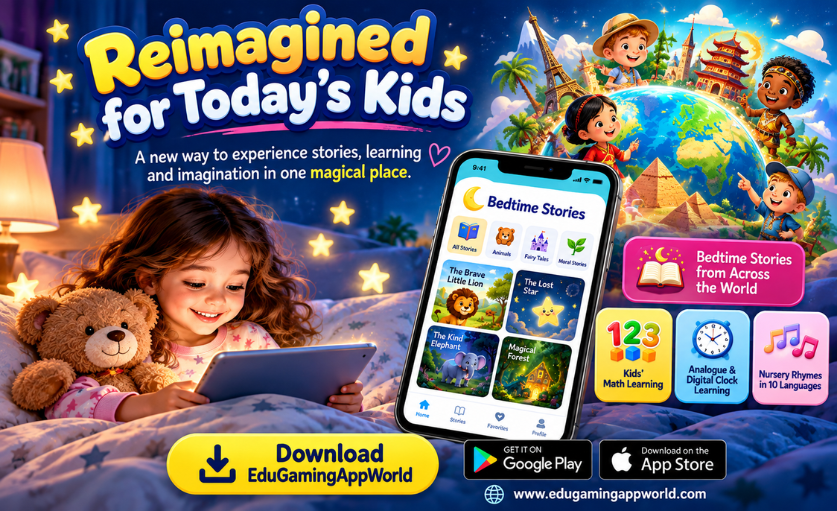
At first the learning time might seem difficult but interactive instructional activities make the process fun and interesting. Instead of memorising numbers, youngsters learn via games, colourful pictures, quizzes and real-life scenarios. Edugamingappworld is an interactive learning platform for kids to learn clock reading while enjoying arithmetic games and nursery songs in a secure ad-free environment.
Why Is It Important For Kids To Learn Time?
Children learn about time as a life skill used every day. Time helps kids become organised and take more responsibility for their activities, from getting ready for school to recognising when it’s time to go to bed.
Learning To Tell Time teaches youngsters various long-term advantages such as:
1. Encourages Independence
2. Enhances Time Management
3. Thinking In Mathematics Develops
4. Improves Memory And Focus
5. Encourages Thinking Skills
6. Helps Kids Keep Track Of Everyday Routines
As youngsters learn about clocks, they start forming links to time and daily occurrences, which helps them develop better organisational abilities.
Difference Between Analogue And Digital Clock
Today’s children witness both analogue and digital clocks in their everyday lives. Knowing two forms helps individuals feel at ease in diverse contexts.
Learn Analogue Clock
Children may learn the link between hours and minutes with the aid of analogue clocks.
Children Learn:
1.Hour Hand
2.Minute hand
3.Clock Numbers.
4.Whole Hours
5.Half Past Hours
6.Quarter Past And Quarter To
Telling time on an analogue clock also promotes counting and number recognition.
Learning Digital Clock
Digital clocks are in watches , TVs , microwaves , tablets and smart phones .
Children Practise .
1. Digital Clock Reading
2. Understanding AM & PM
3. Matching Digital And Analogue Clocks
4. Hours And Minutes Finding
Teaching kids both formats prepares them for real-world use.
Advantages of Interactive Time Learning
Educational games are interactive, and a lot more fun to learn than typical worksheets.
Some Of The Primary Advantages Are:
1. Children’s Engagement
2. Promotes Self-Directed Learning
3. Enhances Concentration And Attentiveness
4. Increases Confidence
5. Learning Is Fun!
6. Develop Early Maths Skills
7. Improves Cognitive Skills
8. Enhances Problem Solving Skills
Children learn best when they are learning as if they were playing. Not doing homework.
Real Life Example
Noah was six years old and would question his parents all the time “What time is it?” since he didn’t know how to read a clock. His parents didn’t bring worksheets but they brought in brief interactive sessions to learn the time every evening.
Noah could in four weeks:
1. Read Basic Analogue Clocks
2. Digital Times Recognition
3. Know School And Bedtime Routines
4. Recognise Hours And Minutes
5. Follow His Own Regimen Everyday
His instructor also observed that he was more self-assured in classroom exercises requiring time.
This example illustrates how interactive learning can turn a tough topic into a fun experience.
Studies Show Interactive Learning Increases Engagement
Game-based learning has been shown in educational studies to improve children’s involvement, motivation and retention of information. Interactive activities provide young learners opportunities forrepeated practice and rapid feedback, helping them grasp skills like reading a clock and organising their daily routines. Educational applications commonly use games, animations and prizes to encourage children to practise consistently. They may be a useful addition to conventional teaching techniques.
Why Select Edugamingappworld?
Parents want education applications that are safe, effective, and built for young learners. Edugamingappworld offers a full educational experience that mixes learning with pleasure.
The Platform Consists Of:
1. Learning On An Interactive Analogue Clock
2. Clock Practise Digital
3. Maths Games For Education
4. Nursery Rhymes In Several Languages
5. Day To Day Activities
6. Interactive Learning Quizs
7. Bright Colourful Animations
8. Child Friendly Interface
9. Completely Free Of Advertisements
Edugamingappworld does not promote passive screen time, but rather encourages kids to engage with games, activities and interactive education. Each exercise is meant to build confidence while developing vital life and academic skills.
Whether your kid is discovering numbers for the first time or starting to read clocks on their own, Edugamingappworld has age appropriate activities to make learning fun everyday.
Tips To Accelerate Kids’ Learning Of Time
Parents may help their child’s growth by doing basic activities at home.
Useful Tips Include:
1. Practise On A Wall Clock Every Day.
2. Comparison Of Analogue And Digital Clocks.
3. Ask Your Youngster What Time Dinner Starts.
4. Create A Colourful Chart Of Your Everyday Routine.
5. Mark Each Learning Success.
6. 15-20 Minutes A Day Of Interactive Practice.
With consistency and encouragement youngsters gain confidence much more rapidly.
Major Advantages Of Learning To Tell Time
1.Supports Time Management Skills
2.Supports Mathematical Understanding
3.Supports Memory And Concentration
4.Improves Reasoning
5.Promotes Self-Learning
6.Adds Fun To Studying Via Interactive Activities
7.Helps Children Confidently With Their Everyday Chores
8.Ready For School And Life
Teaching Kids How To Tell Time Is An Investment In Their Future. Telling time is not merely an academic talent, it’s a life skill that encourages independence, responsibility and confidence. Through interactive games, fun activities and real-life examples, children can learn how to tell time on both analogue and digital clocks, all while having fun along the way.
If you are seeking for a reputable educational platform that makes learning fun then edugamingappworld is a great option. With its interactive clock lessons, mathematical games, nursery rhymes and child-friendly, ad-free environment, young learners have all they need to develop strong basic abilities. Sign up for Edugamingappworld now and transform every minute into a fun chance for your kid to study and develop.
DOWNLOAD APP
Google Play Apple App
FAQ
What is the best age to Learn To Tell Time?
Most children begin learning between 4 and 7 years old, depending on their developmental readiness and exposure to clocks.
Why should children learn both analog and digital clocks?
Learning both formats helps children understand different types of clocks they encounter at school, home, and in everyday life.
How does Edugamingappworld teach children to tell time?
Edugamingappworld offers interactive analog and digital clock activities, educational games, quizzes, and daily routine lessons that make learning engaging and enjoyable.
Can educational games improve time-telling skills?
Yes. Interactive games encourage repeated practice, improve concentration, and help children understand time concepts more effectively than passive learning alone.
Is Edugamingappworld suitable for preschool children?
Yes. Edugamingappworld is designed for children aged 1–8 years and provides age-appropriate educational content including clock learning, maths games, and nursery rhymes in a safe, ad-free environment.