


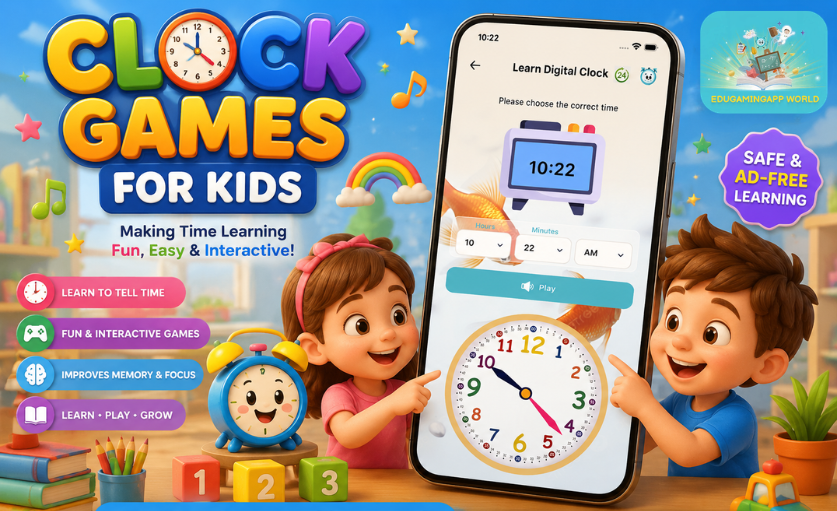
Learning to tell time is one of the most important life skills a youngster should learn. However, young learners often struggle in grasping the distinction between hours, minutes and clock hands. That’s where Clock Games For Kids really come in. The courses are gamified, so kids remain interested while acquiring the skills they need to tell time.
Looking for a fun and instructive approach to educate your kid about time? Edugamingappworld has an amazing clock learning experience that blends interactive games, quizzes and interesting activities in a safe ad-free atmosphere. The platform also has mathematical activities and nursery rhymes making it a comprehensive learning experience for children ages 1-8.
Why Are Clock Games Important For Kids To Play?
Play is the greatest way children learn. Interactive clock games convert typical teachings into engaging challenges that inspire inquiry and active involvement.
Some of the greatest advantages include:
1. Improves Time Telling Skills
2. Develop Logical Thinking
3. Improves Concentration
4. Increases Confidence
5. Allows For Self-Learning
6. Makes Education Entertaining, Not Stressful
They learn time by practicing with fun activities not memorising information.
Characteristics of a Great Clock Learning App
A good clock learning app should include plenty of instructional elements that keep kids interested.
Look for characteristics like:
1. Analogue Clock Games – Interactive
2. Learning Digital Clock
3. Practice 12-Hour & 24-Hour Time
4. Fun Quizzes
5. Things To Do Daily Routine
6. Challenges De Récompense
7. Easy To Use Interface
8. Colourful Animations Safe & Ad-Free Education
The features keep youngsters engaged while they are learning useful, daily skills. Edugamingappworld is a single app that includes interactive clock mastery, arithmetic games and nursery songs.
Real Life Example
Sarah wanted her 5 year old son to know when it was time for breakfast, school and sleep. She offered interactive clock games instead of worksheets. A few weeks of brief daily practice and he was beginning to recognise o’clock and half-past times and was checking the clock before getting ready for school.
This example demonstrates how game-based learning may add additional significance to the daily routines of youngsters.
Why Do Interactive Games Work?
Educational games blend learning with entertainment to keep youngsters interested.
Interactive activities make kids:
1. Match analogue clocks with digital clocks
2. Know the hour and minute
3. Identify everyday routines
4. Develop hand-eye coordination
5. Improve memory
6. Develop problem solving skills
Apps for education may help to engage young learners and make repetitive repetition more fun via games and quizzes.
Why Edugamingappworld?
Edugamingappworld aims to make early education fun and effective. It’s just a single-subject app but a whole educational experience.
It boasts:
1. Clock Games For Kids Interactive
2. Maths Games Learning Analogue & Digital Clocks
3. Kids Songs & Nursery Rhymes
4. Rewards On Stickers
5. Videos For Education
6. Interactive Quizzes
7. Daily Schedule Activities
8. 100% Safe And Ad-Free Environment
It is an app for kids between the ages of 1 and 8 years old, and it is designed to make learning fun via play. It also has interactive clock activities, arithmetic games and nursery songs in several different languages.
Parenting Tips
Here are some easy strategies to help your youngster learn quicker.
1. Practise 15–20 minutes each day.
2. Ask the youngsters to tell what time it is now.
3. Use clocks in your daily life.
4. Celebrate the tiny wins.
5. Mix gaming with real world activities.
6. Learn together, have some fun.
Consistency builds confidence in youngsters over time.
Learning to tell time doesn’t have to be tough. Clock Games For Kids provides fun and engaging games and educational exercises that teach children important time reading abilities. Young learners stay engaged and acquire confidence in daily life via a lively approach to learning.
Edugamingappworld delivers a comprehensive learning experience with interactive clock games, arithmetic tasks and nursery rhymes in one safe kid friendly platform, if you are seeking for an engaging educational app. For parents who want their kids to learn and have fun at the same time, it’s a great option.
Start your kid’s voyage of learning clocks now with Edugamingappworld and make every minute into a fun-filled learning experience!
DOWNLOAD APP
Google Play Apple App
FAQ
What are Clock Games For Kids?
Clock Games For Kids are interactive educational games that teach children how to read analog and digital clocks in a fun and engaging way. These games use colorful visuals, quizzes, and activities to help kids understand hours, minutes, and daily routines while improving their time-telling skills.
At what age can children start playing Clock Games For Kids?
Most Clock Games For Kids are designed for children aged 3 to 8 years. Preschoolers can begin learning basic clock concepts, while older children can practice reading both analog and digital clocks through interactive challenges and educational activities.
How do Clock Games For Kids improve learning?
Clock Games For Kids make learning enjoyable by combining education with play. They help improve memory, concentration, logical thinking, problem-solving skills, and confidence while teaching children to recognize time through fun games and real-life scenarios.
Why should parents choose Edugamingappworld for clock learning?
Edugamingappworld offers a safe, ad-free learning experience with interactive analog and digital clock activities, maths games, nursery rhymes, and daily routine exercises. The app is designed to make learning enjoyable while helping children build essential educational and cognitive skills.
Can Clock Games For Kids help children understand daily routines?
Yes. Clock Games For Kids teach children how to associate specific times with everyday activities such as waking up, going to school, mealtime, playtime, and bedtime. This helps them develop better time management habits and become more independent in their daily routines.