


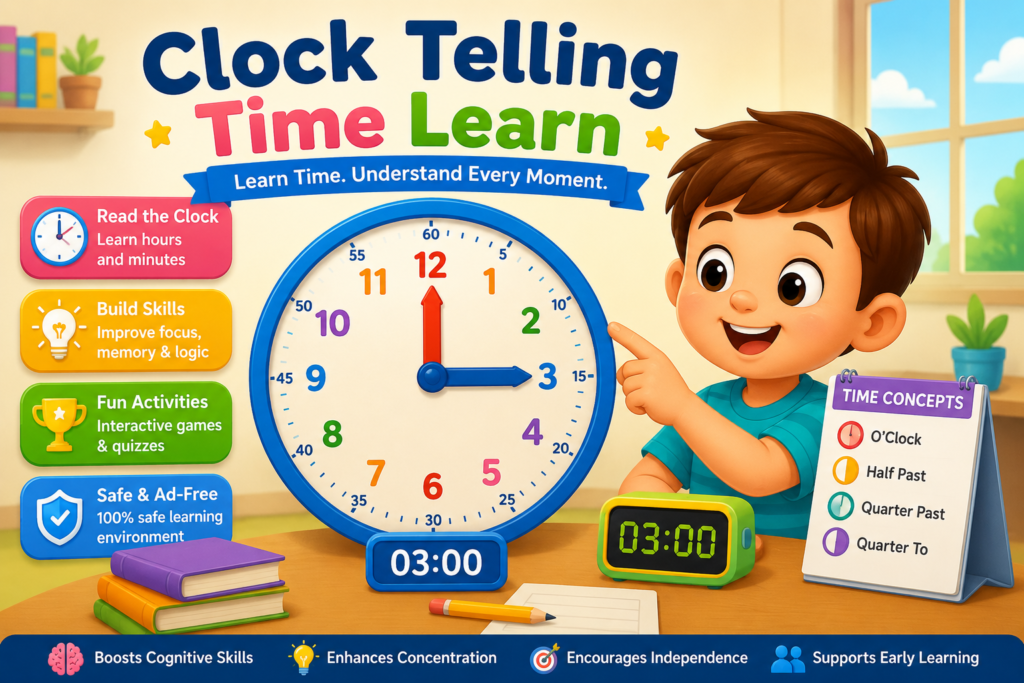
Time is one of the most important lessons that children need to acquire as they grow. Getting up for school, going to activities, completing homework, etc. are all part of everyday life and time management is a crucial part of that. Teaching children to read clocks at a young age makes them more independent, responsible and structured. This is where Clock Telling Time Learn activities are an integral part of early childhood education.
Numbers, letters and colours are what many parents work on, but time is just as important. Learning to tell time helps youngsters improve their mathematical thinking, problem-solving abilities and life skills that will be useful for them for years to come.
It Is Important For Youngsters To Have Time To Study.
Telling time is more than just counting digits on the clock. It helps children plan their day, coordinate events and foster a sense of responsibility.
Research in education reveals that pupils with superior abilities of time awareness are more likely to have better organisational skills and greater classroom performance. Research suggests that structured learning activities might promote children’s cognitive maturation and executive functioning skills that are important for decision making and self-management.
Kids Learn About Concepts Such As To Tell Time:
1. Good Morning, Good Afternoon, Good Evening
2. Day-To-Day Lives.
3. Waiting And Patience
4. Planning Work
5. Time Management
These abilities play a crucial role during a child’s whole development.
The Basics of Reading a Clock – Introduction
At first it could seem difficult teaching children to tell the time on analogue and digital clocks. But the process becomes exciting and entertaining using interactive learning techniques.
Children learn to identify numerals for the first time on the face of a clock. The children know where the numbers are . They understand the functions of the hour hand and the minute hand .
Through these exercises kids are learning about topics such as telling time on the clock:
1. Full Time Hours
2. Half Hours
3. A Quarter Past
4. To Minutes Seconds
For kids, these concepts are more useful to learn via interactive games and visual learning experiences rather than typical memorisation methods.
Real Life Example: Learning in Daily Life
Now image a six-year-old youngster Aarohi who found it difficult to get a hang of the everyday rituals. She would ask her parents often whether it was time for school, for lunch or for bed.
Her parents employed simple games for telling the time and fun activities. They had her check the time before all sorts of mundane things. Within weeks, Aarohi was identifying times on her own.
Soon she learned to prepare for school, complete homework, and take part in extracurricular activities. As her understanding of time grew, so did her confidence and independence substantially expand.
This narrative is an example of how practical clock-learning experiences may have a favourable effect on the daily life of a young person.
Benefits of Clock Telling Time Activities Learn
1. Sharpen Math Skills
For youngsters, time learning is counting by fives and seeing patterns and understanding numerical relationships. These skills support general progress in mathematics.
2. Enhances Cognitive Development
Clock reading helps to develop critical thinking, memory and problem solving skills”.
3. Supports Independence
A child with an understanding of time is better able to organise his or her own daily routine and responsibilities.
4. Enhances Decision-Making Skills
When youngsters know how much time they have for activities they are better able to make appropriate decisions and gain planning abilities.
5. Encourages Accountability
An sense of time gives responsibility and youngsters learn timelines and obligations matter.
The Function Of Educational Technology In The Period Of Learning.
Modern schooling technology has altered how students learn important concepts such as time. Interactive educational apps use bright visuals, animations, awards and games to keep kids engaged.
Research has shown that children learn better when the material that is being taught to them is supplemented by visual, auditory and interactive interactions. Children consider doing their school work to be a joyful challenge, not a hard duty.
Interactive clock-learning activities provide repeated repetition with quick feedback for increased confidence and learning retention for kids.
Why Parents Choose Edugamingappworld
Parents that want a thorough education choice desire more than just basic games. They desire interesting learning experiences that foster children’s growth in many disciplines.
We are devoted to fostering a fun, inclusive learning environment for every youngster. Next-gen educational learning apps Its goal is to strengthen cognitive powers, to stimulate creativity, to foster imagination, to improve decision-making skills and to assist collaboration.
What makes Edugamingappworld stand out is its promise to blend education with involvement. This website provides youngsters with interactive learning experiences to master basic concepts like clock learning, mathematics, problem solving and creativity via enjoyable games.
If you are a parent looking for educational resources to assist develop your children in all areas, Edugamingappworld offers a full learning setting that can keep children interested and motivated to learn. The platform provides joyful and inclusive learning experiences for children and reassures parents about their learning journey.
Families that choose Edugamingappworld will get educational material designed to foster independence in kids and to inculcate habits of lifelong learning.
How to Teach Time at Home
Parents may reinforce time-learning abilities via simple daily activities:
1.Have Kids Tell Time.
2.Make A Visible Routine For Each Day.
3.Use A Practice Clock.
4.Associate Clock Times With Everyday Events.
5.Play Several Educative Clock Games.
As they practise regularly, children slowly get more accustomed and competent with the notions of time.
Learning time is a significant life skill that encourages independence, organization, and academic success. Clock Telling Time Learn activities are incredibly engaging and assist young people develop critical maths, cognitive and decision-making abilities as well as confidence in their daily routine.
Learning time is more exciting and effective than ever before with today’s interactive learning experiences. If parents choose quality educational resources, they may help their children develop strong foundations for future success.
Comprehensive learning solutions such as Edugamingappworld help youngsters to have meaningful educational experiences that make learning interesting and effective and get them ready for everyday life difficulties.
DOWNLOAD APP
FAQ
1. What is Clock Telling Time Learn for kids?
Clock Telling Time Learn is an educational activity that helps children understand how to read analog and digital clocks. It teaches kids important time concepts through fun, interactive learning methods.
2. At what age should children start learning to tell time?
Most children can begin learning basic clock concepts between ages 4 and 6. Simple activities and visual games can help them gradually understand hours, minutes, and daily schedules.
3. How does Clock Telling Time Learn improve a child’s skills?
Clock Telling Time Learn enhances mathematical thinking, problem-solving abilities, time management skills, and cognitive development. It also helps children become more independent in their daily routines.
4. What is the best way to teach children how to tell time?
The best approach combines hands-on practice, interactive games, analog and digital clocks, and real-life examples. Fun educational apps and activities can make learning time easier and more enjoyable.
5. Why is learning to tell time important for preschoolers and young children?
Learning to tell time helps children understand schedules, routines, and responsibilities. It builds confidence, improves organization skills, and prepares them for everyday activities at home and school.