


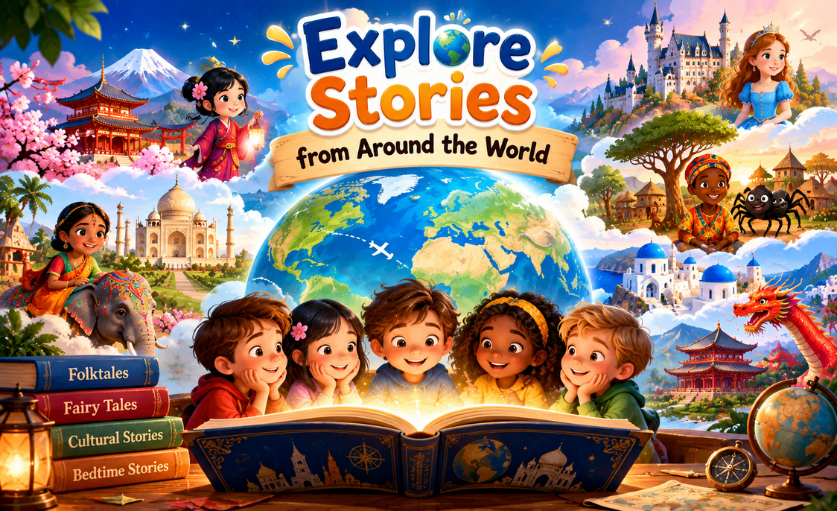
Each story is a doorway to a new journey. From the comfort of home, a youngster can visit a mystical forest, meet an intelligent animal, visit a far away kingdom, or learn about traditions from another area of the world.
Bedtime isn’t just a habit anymore, as families are exploring stories from around the world. It becomes a chance to experience new cultures, to ignite imagination and share moments of meaning together. Children’s stories are full of interesting characters and concepts for young readers, from Indian folktales and Japanese fables to African storytelling traditions.
If you’re a parent looking for bedtime stories for kids or a teacher looking for fun reading exercises, world stories are a great way to combine enjoyment with learning.
Why Read Stories From The Rest Of The World?
Stories are a fun way for kids to learn about other places, see things from new viewpoints and think about the world outside their normal lives.
1. Promote Imagination And Creativity
A narrative with a talking animal, a magical garden, or a strong young hero stimulates kids to anticipate possibilities beyond the everyday. Parents can make reading participatory by asking questions like, “What do you think will happen next?”
These brief talks inspire children to think out of the box and share their thoughts.
2. Learn About Different Cultures And Traditions
Children’s cultural stories can be a way to introduce traditional holidays, family practices, local landscapes, and community values. Children learn that individuals in different parts of the world may live differently, but they share feelings such as love, friendship, hope, and curiosity.
3. Discover Life Lessons In Stories
Many classic stories talk about kindness, courage, honesty, patience and cooperation. Discussing the choices a character makes helps youngsters think about how their own actions influence others.
Instead than just telling a moral, ask your child what they would have done if they were the character.
Discover Amazing Storytelling Traditions From Around The World
Every location has its own storytelling past. Learning about these traditions helps youngsters realise the multitude of stories that have been told over many centuries.
Indian Folktales: Animal Stories And Their Lessons
India has an extensive heritage of storytelling, one of which is the Panchatantra, a well-known collection of animal stories frequently connected with practical wisdom and wise decision-making.
These stories could involve animals talking, making friends, overcoming hurdles and solving issues. Their adventures give children ways to reflect about teamwork, ingenuity, honesty and results of choices.
Parents might question young readers to identify the character who made the best choice and why.
Japanese Folktales Adventures And Courage
In Japanese legend there is Momotaro, usually known in English as the Peach Boy. The familiar version is a boy born inside a peach, who grows up to go on an adventure with animal friends.
This narrative gives you possibilities to talk about courage, friendship, teamwork and helping others. And the tellings can differ quite a bit, so it’s intriguing to compare stories.
The Clever Anansi: Storytelling In West Africa
Anansi stories are part of the oral traditions of the Akan people and are widely recognised in some form throughout West Africa and the Caribbean.
Anansi is generally depicted as a crafty spider character whose plots lead to unanticipated ends. These stories can teach youngsters to think about intellect, responsibility, and the difference between being brilliant and acting wisely.
European Fairy Tales: Enchanted Worlds
Enchanted artefacts, strange woodlands, helpful friends, and surprising transformations are common elements in many of the fairy tales of the European storytelling tradition.
Stories like Cinderella have several variants in different cultures. By reading the two versions side by side, children may see that people, settings and details might be different, but some themes will be recognisable.
Chinese Folktales: Legends And Meaningful Adventures
Chinese folklore refers to an extensive body of mythology and traditional tales including heroes, supernatural entities, animals and heroic deeds.
Retellings can be a way of introducing youngsters to traditional tale telling, and teaching that individual stories belong to certain historical and cultural settings.
These instances are just the tip of the iceberg. There are so many different storytelling traditions in the globe to explore.”
How To Pick The Best Bedtime Stories For Kids
A good choice of book can make reading time more enjoyable and more comfortable.
- Consider Your Child’s Age: For younger children, short stories with simple language and familiar scenarios could be more appropriate.
- Choose Relevant Topics. Select stuff that is suited for your child’s level of comprehension and sensitivity.
- Make It Fun And Educational: Stories should be engaging, not another homework assignment
- Follow Your Child’s Interests :Animals, adventures, mystical realms and humorous characters all encourage a love of reading.
- Discover Cultures: Share tales from many parts of the world, without assuming that a single tale stands for an entire nation or group.
A good bedtime tale is one your youngster likes, and wants to discuss about later.
Easy Ways To Make Storytime More Interactive
You don’t need anything else to make a bedtime tale a wonderful family experience.
- Develop A Story Map : Locate the country or region of origin of a tale on a map. Discuss its landscapes, languages and traditions using factual, age-appropriate facts.
- Draw Someone You Love : Have your youngster draw the hero or an animal companion, or an imaginary location from the novel.
- Take Two Stories : Read stories from other places, talk about how the characters handle difficulties.
- Use Open-Ended Enquiries : Questions like “Why do you think the character did that?” promote serious conversation.
- Make Up A Fresh Ending: Have your child come up with an alternate conclusion or a fresh adventure for the characters.
These activities assist to make reading a social activity rather than a passive one.
Educational Bedtime Stories: The Benefits For Learning
Children’s bedtime stories are educational in that they are fun, but also they help children explore language, feelings, ideas and points of view.
When youngsters listen to stories, they are introduced to new terminology, they follow sequences of events, and they learn how to describe characters and situations. Discussing a narrative might also help children exercise giving opinions and thinking about how other people might feel.
Storytelling offers significant opportunities for connection. Storytime can be a nice aspect of family life with a quiet, familiar evening routine.
Families can use a mix of conventional books and good digital storytelling experiences for variety. The secret is to make reading fun and age appropriate and interesting to the child.
Bedtime Stories With Edugamingappworld Discover
Looking for fun methods to get kids started on stories and cultural traditions?
Discover bedtime stories on Edugamingappworld for narrative experiences made for young students. The portal offers bedtime stories from around the world, as well as additional learning experiences including Maths games, learning to tell the time and nursery rhymes.
By telling stories, families bring in a regular reading habit and encourage interest about people and things beyond their local environment.
Make your next bedtime a chance to meet a new character, explore an unknown custom and share a story.
Sharing stories from all around the world gives families a chance to have exciting adventures and learn about diverse cultural practices and points of view. Indian animal tales, Japanese folktales, and West African storytelling. Each tradition brings fresh characters, new situations, and new concepts to explore.
By choosing the right stories, asking basic questions, and establishing a regular reading pattern, parents can make bedtime a time of meaningful connection and discovery.
Edugamingappworld’s Bedtime Stories and begin exploring stories that bring imagination, curiosity, and the joy of reading into your family’s daily routine.
DOWNLOAD APP
Google Play Apple App
FAQ
What does “Explore Stories from Around the World” mean?
It means discovering folktales, fairy tales, legends, and other stories associated with different countries, cultures, and storytelling traditions.
Why are stories from different cultures important for children?
They introduce children to different experiences and perspectives while creating opportunities to discuss empathy, traditions, friendship, and problem-solving.
What are some popular folktales from around the world?
Examples include the Indian Panchatantra animal tales, the Japanese story of Momotaro, and Anansi stories associated with Akan traditions in West Africa. Many tales have different versions and adaptations.
How can bedtime stories help children learn?
Stories expose children to vocabulary, narrative structure, characters, and new ideas. Reading together also encourages conversation, imagination, and shared learning experiences.
What age is suitable for world folktales?
Children can enjoy age-appropriate storytelling from an early age. Choose shorter stories with simple language for younger listeners and more detailed tales as their reading skills and interests develop.