


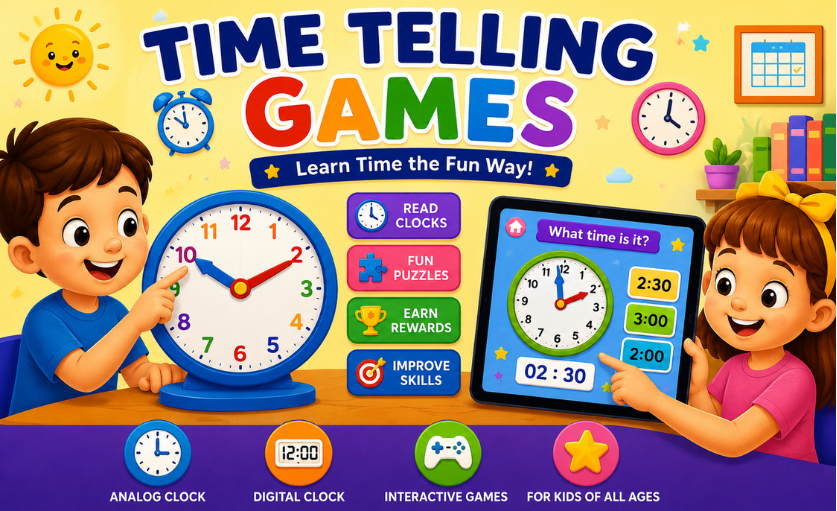
Learning to tell time is one of the most valuable skills children develop during their early years. It helps them understand daily routines, manage schedules, and become more independent. However, learning to read a clock can be challenging when taught only through textbooks or worksheets. That’s why Time Telling Games have become a popular and effective way to make learning enjoyable.
These interactive games combine education with entertainment, allowing children to practice reading clocks, identifying hours and minutes, and understanding the difference between analog and digital time. By turning lessons into fun activities, children stay motivated and learn faster.
What Are Time Telling Games?
Time Telling Games are educational games designed to teach children how to read and understand clocks. They use colorful graphics, interactive challenges, puzzles, quizzes, and rewards to make learning exciting.
Instead of simply memorizing clock hands, children actively participate by matching times, setting clock hands, solving puzzles, and completing engaging activities. This practical approach improves understanding while keeping children entertained.
These games are suitable for preschoolers, kindergarten students, and elementary school children who are beginning to learn about time.
Benefits of Time Telling Games
Interactive learning offers several advantages over traditional teaching methods.
-
Makes Learning Fun
Children naturally enjoy games. When learning is presented as a game, they remain interested and motivated throughout the lesson.
-
Improves Memory
Visual animations, sounds, and interactive challenges help children remember clock concepts more effectively than simple reading.
-
Builds Confidence
Every completed level and correct answer gives children confidence to continue learning.
-
Encourages Independent Learning
Kids can practice at their own speed without feeling pressured, making learning more comfortable and enjoyable.
-
Strengthens Math Skills
Many Time Telling Games also reinforce counting, number recognition, skip counting by fives, and logical thinking.
Analog vs. Digital Clock Learning
Children should understand both analog and digital clocks because they are used in everyday life.
| Analog Clock |
Digital Clock |
| Uses hour and minute hands | Displays numbers |
| Helps children understand time progression | Easier for beginners to recognize |
| Improves logical reasoning | Common on phones, tablets, and computers |
| Encourages visual learning | Supports quick time reading |
Learning both clock formats prepares children for school and daily activities.
Why Kids Should Learn Time Early
Teaching children to tell time is about much more than reading a clock.
It helps them:
- Follow daily routines
- Arrive at school on time
- Understand schedules
- Develop responsibility
- Improve planning skills
- Build independence
Learning time also supports mathematical development because children practice counting, sequencing, and recognizing patterns.
How Interactive Learning Makes a Difference
Traditional worksheets are useful, but interactive activities often keep children engaged for longer periods.
When children play Time Telling Games, they receive immediate feedback, rewards, and encouragement after each correct answer. This positive reinforcement increases motivation and helps them retain new concepts.
Colorful animations, exciting sounds, and simple challenges transform learning into an enjoyable experience rather than a difficult task.
Features to Look for in Quality Time Telling Games
The best educational games should include:
- Analog clock practice
- Digital clock activities
- Interactive quizzes
- Easy-to-understand instructions
- Reward-based challenges
- Colorful graphics
- Age-appropriate learning levels
- Safe, child-friendly interface
These features create a balanced learning experience that keeps children interested while building essential skills.
Real-Life Example
Six-year-old Sophia enjoyed playing educational games but found reading an analog clock difficult. Her parents introduced her to interactive Time Telling Games that allowed her to move clock hands, answer quizzes, and earn rewards.
After practicing for just 15 minutes each day, Sophia became confident identifying hours, half-hours, and quarter-hours. Within a few weeks, she could read the classroom clock independently and proudly tell her family the correct time.
This example highlights how game-based learning can make complex concepts easier for young learners.
Tips for Parents
Parents play an important role in helping children master time-telling skills.
Here are a few simple tips:
- Practice reading clocks every day.
- Ask children what time meals or bedtime begin.
- Use wall clocks to explain hours and minutes.
- Celebrate every small achievement.
- Combine traditional learning with interactive educational games.
Regular practice builds confidence and improves understanding over time.
Why Choose Edugamingappworld?
Edugamingappworld offers an engaging learning environment where children can improve their educational skills through fun and interactive activities.
The app provides:
- Interactive Time Telling Games
- Analog and digital clock learning
- Number recognition
- Counting activities
- Math games
- Colorful animations
- Reward-based learning
- Child-friendly design
- Safe and ad-free experience
These features help children enjoy learning while developing valuable everyday skills.
Conclusion
Learning to tell time is an essential life skill that becomes much easier when children enjoy the learning process. Time Telling Games provide an engaging, interactive, and rewarding way for kids to understand analog and digital clocks while strengthening their confidence and mathematical thinking.
Whether your child is just beginning to learn about time or needs extra practice, educational games offer a fun alternative to traditional teaching methods. By combining colorful visuals, interactive challenges, and rewarding activities, children stay motivated and continue improving every day.
If you’re looking for an enjoyable way to help your child master time and build early math skills, explore the Edugamingappworld Math App today.
Frequently Asked Questions
1. What are Time Telling Games?
They are interactive educational games that teach children how to read analog and digital clocks through engaging activities.
2. What age is best for learning time?
Most children begin learning basic time concepts between the ages of 5 and 8, although readiness varies by child.
3. Why should children learn both analog and digital clocks?
Learning both formats helps children confidently understand time in different everyday situations.
4. Are interactive games better than worksheets?
Interactive games make learning more engaging and often improve motivation, while worksheets can be used as additional practice.
5. Where can parents find educational time-learning activities?
Parents can explore interactive learning experiences through the Edugamingappworld Math App.