


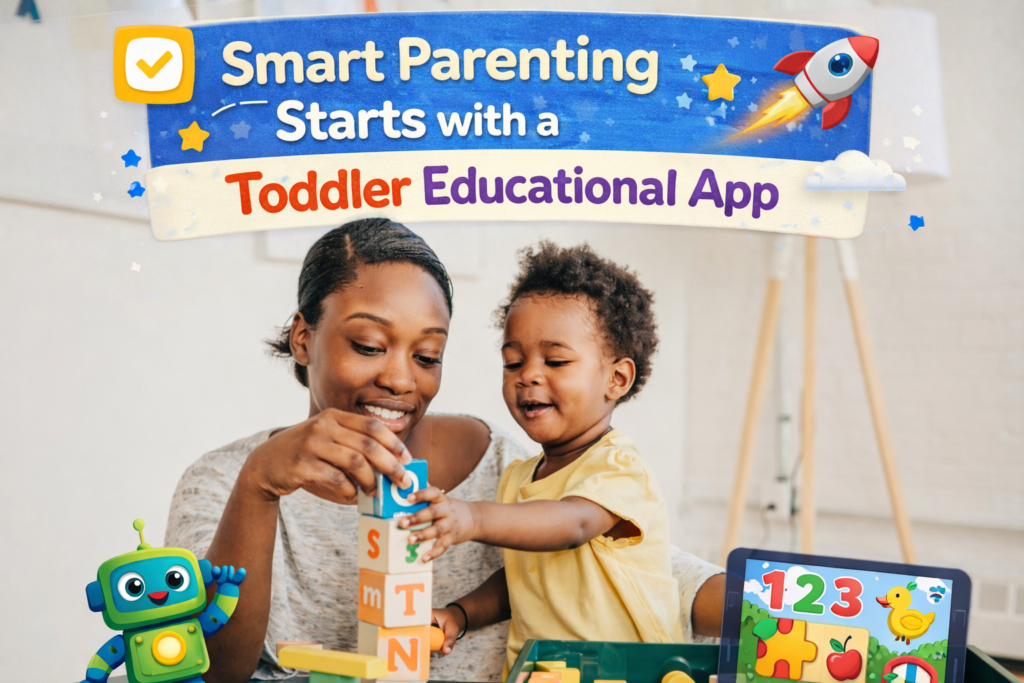
If you think a Toddler Educational App is just a way to keep your child busy while you finish your coffee, you’re underestimating both the opportunity and the risk.
Early childhood is not a casual phase. It’s the most critical stage of brain development. According to the CDC and multiple early learning studies, nearly 90% of a child’s brain develops before the age of five. That’s not a small window. That’s a once-in-a-lifetime opportunity.
The real question is simple:
Are you using that window wisely, or wasting it on random screen time?
The Reality of Modern Parenting
Let’s be honest. Toddlers today grow up in a digital world. Avoiding screens completely isn’t realistic. Research from Common Sense Media shows that children under age 5 spend an average of about 2–3 hours per day on screens. That time will happen whether you like it or not.
So you have two options:
- Passive entertainment that overstimulates and distracts.
- Structured digital learning that builds real cognitive skills.
Only one of those options actually supports development.
A well-designed Toddler Educational App doesn’t just entertain. It teaches pattern recognition, early math, vocabulary, memory skills, and logical reasoning — all during the most formative stage of growth.
Real-Life Example: Screen Time Done Right
Take a simple example.
A three-year-old struggling with color recognition and basic counting. Instead of flashcards and repetitive drills (which often fail because toddlers lose focus), the parent introduces a structured interactive learning app.
Within weeks, the child starts identifying colors confidently, counting objects correctly, and even correcting mistakes independently.
Why? Because interactive learning activates multiple areas of the brain simultaneously. When toddlers see, hear, and interact with content at the same time, retention increases significantly compared to passive watching.
This isn’t theory. Studies in early childhood education show that interactive digital learning can improve early literacy and numeracy outcomes when designed intentionally.
The keyword here is intentionally.
Not every app qualifies.
What Makes a Toddler Educational App Actually Effective?
Here’s where most parents get it wrong. They download the first colorful app they see and assume it’s educational.
Bright animations do not equal learning.
A real Toddler Educational App should:
- Build cognitive development step by step
- Encourage problem-solving rather than mindless tapping
- Promote creativity and imagination
- Develop early decision-making skills
- Support memory retention and logical sequencing
- Encourage teamwork and collaboration where possible
If the app just rewards endless tapping with sound effects, it’s not building skills. It’s building dependency.
The Long-Term Impact You Can’t Ignore
Let’s zoom out.
Children who develop strong cognitive and problem-solving skills before kindergarten are significantly more likely to perform well academically later. Longitudinal education research consistently shows early learning foundations directly impact later reading proficiency and math performance.
Early gaps compound over time.
A small delay in cognitive stimulation at age three doesn’t stay small. It multiplies.
That’s why the quality of early digital exposure matters. It’s not about “more screen time.” It’s about smarter screen time.
Why Edugamingappworld Stands Out
Now let’s talk about execution.
Edugamingappworld is not another flashy app with random mini-games. It is built specifically to develop cognitive abilities, increase creativity, strengthen imagination, enhance decision-making skills, and facilitate teamwork among children and young adults worldwide.
That combination matters.
Instead of isolated activities, the platform focuses on structured learning pathways. That means progression is intentional. Skills build on top of each other. Children aren’t just playing — they’re developing.
Here’s why that’s impactful:
- Cognitive development is strengthened through interactive challenges
- Creativity is encouraged through imaginative problem-based scenarios
- Decision-making skills are developed by requiring thoughtful choices
- Team-based activities promote collaboration rather than isolation
Most apps focus on short-term engagement. Edugamingappworld focuses on long-term growth.
If you are a parent actively seeking a service that contributes to your child’s development rather than just filling time, the difference is obvious.
Service That Actually Supports Development
Choosing Edugamingappworld isn’t about downloading another app. It’s about investing in structured early learning.
The service is designed to:
- Support developmental milestones
- Provide age-appropriate learning challenges
- Encourage independent thinking
- Build foundational academic readiness
- Strengthen attention span and focus
And let’s be clear — these aren’t “nice-to-have” skills. They are survival skills in modern education systems.
Children entering school today are expected to recognize letters, count objects, follow instructions, and solve basic problems. Those who aren’t prepared often struggle early — and early struggles damage confidence.
Confidence at age four is not trivial. It shapes classroom participation, social interaction, and willingness to learn.
Edugamingappworld addresses this before it becomes a problem.
The Cost of Doing Nothing
Here’s the uncomfortable truth.
If your toddler spends hours daily on unstructured entertainment apps, you are training their brain for passive consumption.
Short attention spans.
Low frustration tolerance.
Instant reward dependency.
That pattern is difficult to reverse later.
On the other hand, structured interactive learning trains:
- Patience
- Logical thinking
- Memory recall
- Strategic decision-making
The difference compounds over years.
This is not about being dramatic. It’s about understanding developmental momentum.
The Smart Choice for Service Seekers
If you’re actively searching for a learning-focused digital solution, you’re already ahead of many parents.
But don’t settle for surface-level education.
A powerful Toddler Educational App should challenge your child, stretch their thinking, and build real skills. It should combine engagement with intentional development.
Edugamingappworld delivers that balance.
You don’t need more noise on your child’s tablet. You need structured growth disguised as play.
And in a world where early development determines future outcomes more than ever, making the right choice now is not optional — it’s strategic.
The window before age five closes fast.
The question is whether you’re going to use it wisely.
- What is a Toddler Educational App and how is it different from regular kids’ apps?
A Toddler Educational App is specifically designed to support early childhood development rather than just entertain. Unlike regular kids’ apps that focus on bright animations and quick rewards, educational apps are structured to build cognitive skills such as memory, problem-solving, early math, language recognition, and decision-making. The difference is simple: one passes time, the other builds ability. - At what age should a child start using a Toddler Educational App?
Most toddlers can begin using a structured educational app between ages 2 and 3, depending on their attention span and motor skills. Research shows that nearly 90% of brain development occurs before age five, making early exposure to guided learning tools highly beneficial. However, usage should be intentional, limited in duration, and ideally supervised to maximize impact. - How much screen time is appropriate when using a Toddler Educational App?
Experts generally recommend limiting screen time for toddlers to about 1 hour per day of high-quality content. The key is not the quantity but the quality. A structured learning session using a purposeful educational app is far more beneficial than extended passive entertainment. Short, focused sessions tend to improve retention and prevent overstimulation. - What skills can a Toddler Educational App help develop?
A well-designed Toddler Educational App can support:
- Early literacy (letters, phonics, vocabulary)
- Basic numeracy (counting, shapes, patterns)
- Memory and attention skills
- Logical thinking and problem-solving
- Creativity and imagination
- Early decision-making abilities
Apps that combine interactive challenges with progressive difficulty levels tend to produce better developmental outcomes.
- How do I choose the right Toddler Educational App for my child?
Look for an app that has structured learning pathways, age-appropriate challenges, and activities that require thinking rather than repetitive tapping. It should promote active participation, not passive watching. Avoid apps that rely solely on flashy graphics and constant rewards. The right choice will engage your child while building measurable skills that support long-term academic readiness.