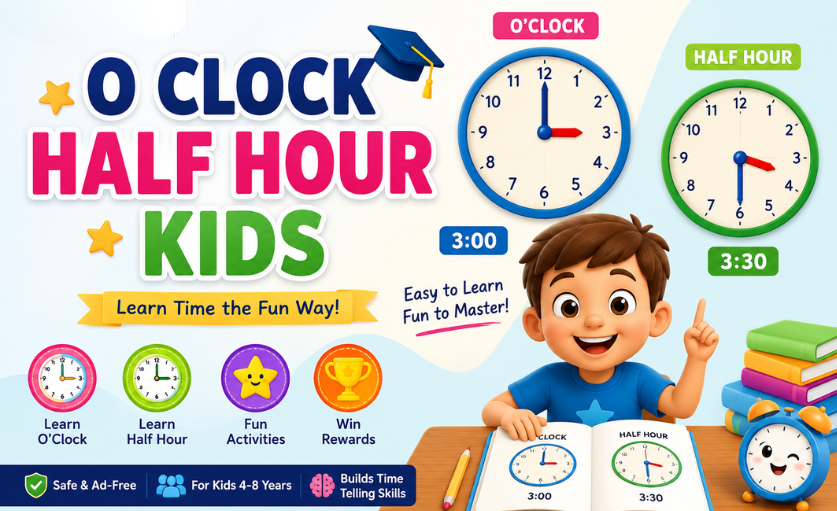
One of the primary milestones of early education for children is learning to tell time. O Clock Half Hour Kids concepts help children to become more confident, organised and autonomous in their daily lives. Learning to read a clock teaches youngsters about life, from when it’s time to go to school to when it’s time for bed.
Children sometimes misunderstand clocks at first but learning to tell time may be fun instead of challenging with the right activities, games, and visual learning strategies. You learn best when it is entertaining and you are learning together. So that kids may recall things better.
What’s O Clock?
The first thing to know about time is to know o’clock.
If the minute hand points directly at the number 12, then it is on the hour. The hour hand shows the current hour.
For example we have
- 1:00 = One o’clock
- 4:00 = Four o’clock
- 7:00 = Seven o’clock
- 10:00 = Ten o’clock
Once babies see this fundamental pattern, it gives them an excellent foundation for more complex ideas of time.
Half Hour to Understanding
When children can tell o’clock, they are ready to learn half past or half hour.
A half hour is 30 minutes after the hour. The minute hand of the analogue clock is at 6.
These include
- 2:30 = Two Thirty
- 5:30 = Five Thirty Or Half Past Five
- 8:30 = Eight Thirty
- Half Eleven = 11.30 A.M.
At half past the hour hand is half way between two numerals so youngsters are able to see that time is continually moving .
The step by step understanding of O Clock Half Hour Kids ideas makes them feel more manageable and less intimidating.
Why Is Learning Time Important For Children?
Reading numerals on a clock is a little part of telling time. It teaches children vital abilities that they will use every day.
Advantages Of:
1. Encourages independence
2. Improves logical reasoning skills
3. Develops math knowledge
4. Encourages responsibility
5. Helps kids stay on a schedule
6. Improves observation capabilities
Children who know the time often feel more competent handling school schedules, school work, lunches and playtime.
Creative Ways To Teach Kids O’clock Half Hour
Children learn best while active. They should learn, play and practise, not learn by heart.
1. Employ Real Time Clocks
Show children an analogue wall clock or a learning clock. Put your hands together and ask simple questions, like:
- What time is lunch?
- What time do you get up?
- What hour sleep you?
Time is related to daily life, and children learn to respect it.
2. Games (Interactive)
Educational games make learning fun.
Children can:
- Match analogue and digital clock
- Adjust the clock hands to the right time.
- Fun quizzes
- Receive bonuses upon task completion
Interactive learning is fun for youngsters and helps reinforce important subjects.
3. Routine of daily practice
Create learning opportunities from ordinary events.
Something like:
- 7:00 – Wake up
- 8:30 – School 12:00 – Lunch break
- 3:30 – Time to play
- 8:00 – sleep time
It helps children understand the concept of time in context.
4.Card
Make colourful flashcards with different times on the clock.
Ask children to:
- Look at the clock
- Speak the time aloud
- Match same times;
Repeating these tasks increases memory and confidence.
5. Activities for Drawing Clocks
Provide students with blank clock faces and have them sketch the hour and minute hands to show different times.
It helps them get a visual understanding and helps reinforce their learning.
Common Mistakes Of Children
Kids make mistakes, that’s normal and it takes practice to learn time.
Some of these challenges include:
- Confusing the hour and minute hands
- Forget Minute hand on 12 Twelve o’clock 1?2 hour reading wrong
- Combination clock (analogue-digital)
- Like the hour hand crawling from one numeral to another
Parents and teachers should encourage pupils to be patient and to recognise small gains to build confidence.
Advice for Teachers and Parents
Children do not need long hours of study to learn the time. Just a few minutes a day can make all the difference.
Here are some useful tips:
- Practice 10-15 Minutes Daily.
- Use Colourful Teaching Materials.
- Ask About Time During The Day.
- Reward Right Answer
- . Make Learning A Fun And Not A Lesson.
Positive reinforcement helps keep children interested and engaged.
The Advantages of Learning with Educational Apps
Today, learning time for kids is entertaining and interactive through educational apps.
Kids can do more than just read books.
- Rotate Clock Hands
- Thoroughly Exciting Jobs
- Watch Animated Videos, Play Games That Teach
- Receive Instant Feedback
- Learn At Their Own Pace
Children understand quickly and stay engaged with the participative approach.
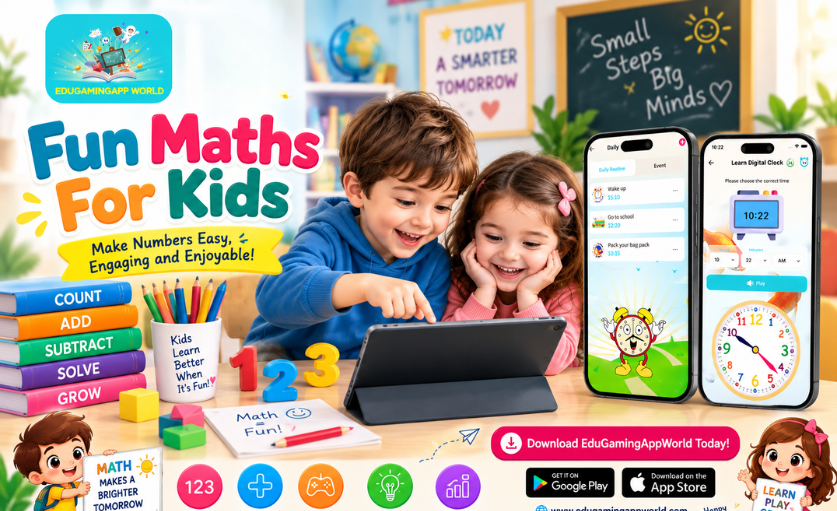
Edugamingappworld Time Learn
Edugamingappworld makes learning O Clock Half Hour youngsters concepts entertaining for youngsters through interactive learning.
The app includes:
What an Analogue Clock Can Teach Us
- Digital clocking exercise.
- Activities O’Clock
- 30 min workout
- Interactive Quizzes
- Games with prizes
- Family-friendly interface
- Safe learning environment without advertisements
The software is intended for young learners and allows them to develop confidence and have fun in every session. Parents can also use fun, instructive activities to track development as youngsters learn critical time-telling skills.
Learning O Clock Half Hour Kids is a very vital aspect of a child’s education. Learning about clocks and half-hours also provides children essential life skills to allow them to become more independent, organised and confident.
Learning time is easy and pleasant with regular practice, interesting games and interactive activities! By combining education with pleasure, Edugamingappworld makes the journey more enjoyable. Children learn how to tell time through interesting activities, vibrant teachings and engaging and gratifying clock games. Elevate your child’s learning experience today with Edugamingappworld and turn every moment into a productive learning experience.
FAQ
1.What does “O Clock Half Hour Kids” mean?
O Clock Half Hour Kids refers to teaching children how to read clocks by understanding whole hours (o’clock) and half hours (half past). These basic time-telling skills help kids build a strong foundation before learning quarter past, quarter to, and other advanced time concepts.
2. At what age should children learn O Clock and Half Hour?
Most children begin learning O Clock Half Hour Kids concepts between the ages of 5 and 7. With regular practice, interactive games, and visual learning activities, they can quickly recognize o’clock and half-hour times on both analog and digital clocks.
3. How can I teach O Clock Half Hour Kids in a fun way?
You can teach O Clock Half Hour Kids using interactive clock games, educational apps, flashcards, toy clocks, and daily routine activities. Connecting clock reading with everyday events like mealtime or bedtime makes learning more enjoyable and easier to understand.