The early years of childhood are a time of exploration and discovery. Children learn to see numbers in the world around them, counting toys, seeing numbers on clocks, books and signs. Natural moments of interest can be turned into fun learning experiences with Number Games Preschool activities. Interactive number games encourage youngsters to explore basic maths ideas via interaction, repetition and imagination, rather than worksheets alone.
It is not the goal for preschoolers to master sophisticated maths for parents and teachers. It is designed to help students feel at ease with numbers and to acquire skills like counting, recognising numerals, comparing quantities and comprehending simple patterns.
The Importance Of Number Learning In Preschool
Numbers are the life of everyday. Children come upon them while counting steps or sharing toys, choosing a page in a book or talking about how many objects they have. This means early number encounters can help youngsters make connections between mathematical ideas and the world around them.
Preschool Number Activities Can Introduce Ideas Like:
- Number Identification
- Counting Stuff
- Matching Numbers To Quantities
- Comparison More And Less
- Basic Subtraction And Addition
- Number Sequence
- Types And Varieties
When these ideas are expressed as games, youngsters are able to participate actively rather than merely memorise responses.
What Makes Number Games Work?
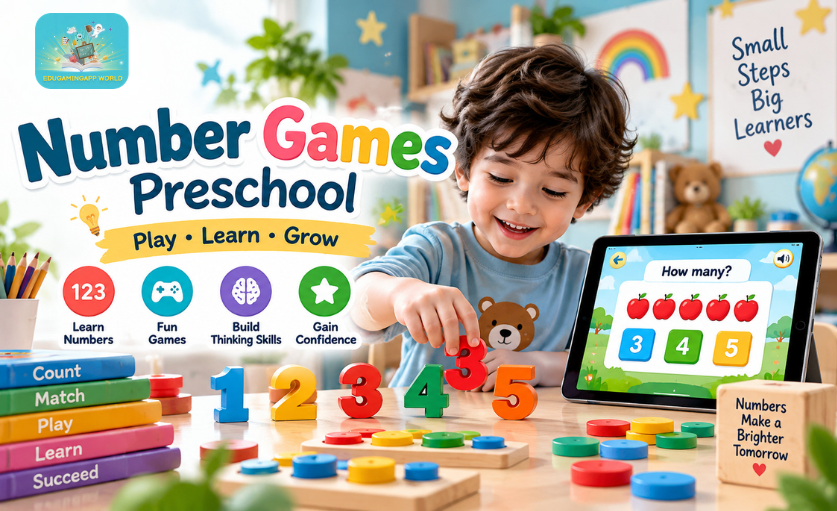
It should be easy enough for a small child to grasp, yet engaging enough to make them want to join in. Number Games Preschool exercises perform best when they include visual aspects, movement, audio and hands-on interaction.
For example, a kid might be instructed to match the number “4” to four brightly coloured blocks. This ties the written numeral to an actual quantity.
And repetition matters, too. Young children learn best when they see the same concepts presented in different ways. One exercise could be counting animals and another could be matching numbers or completing a short sequence.
Fun Activities For Preschoolers
Parents and teachers can provide many simple activities in the classroom or at home.
1. Count And Match
On a table, place numerous groups of objects. Have the youngster count each group and match it to the right number card.
For example, a collection of five blocks can be matched to the number 5. This helps children to connect numbers to written numerals.
2. Number Search
Make number recognition a mini treasure hunt. Scatter number cards throughout a room and tell youngsters to find a particular number.
You can make it more tough by asking them to find numbers in sequence like 1, 2, 3, 4 and 5.
3. Toys FOR Counting
Everyday toys can be easy learning aids. Have the children count vehicles, dolls, blocks, or animals. Then ask questions like, “How many are there?” or “Can you add one more?”
This makes arithmetic feel applicable to everyday things.
4. Match Number And Shape
Number shapes. Give them cards with varying numbers and groups of shapes. They can match a number to the corresponding quantity.
This activity can support early number recognition and visual matching skills.
5. Counting Games
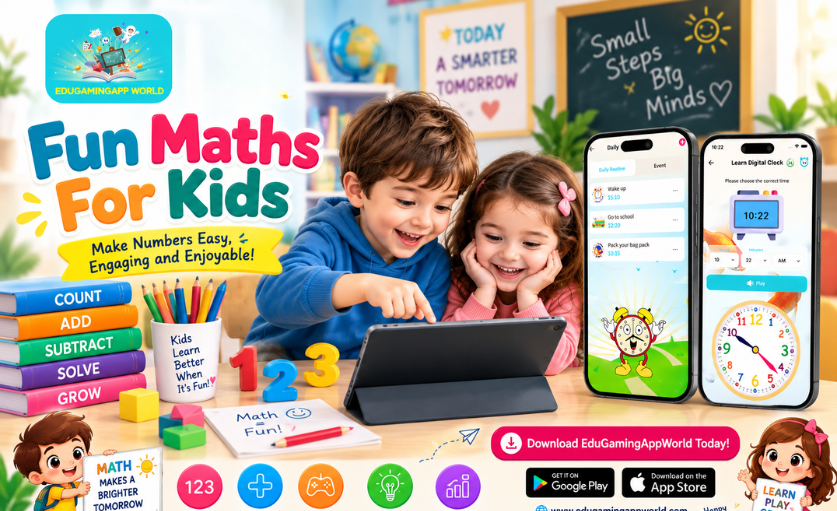
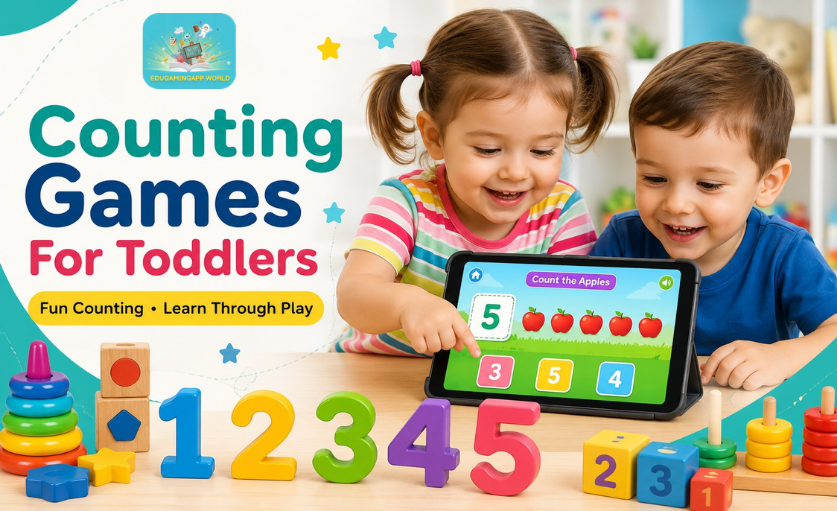
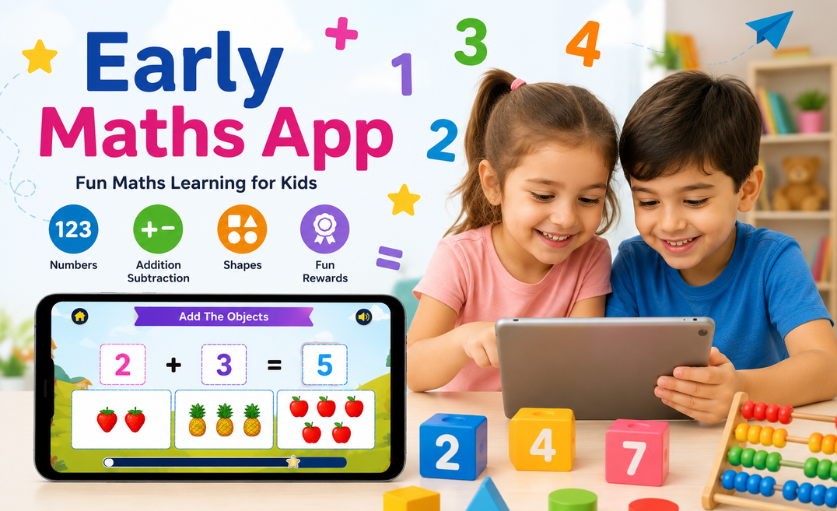
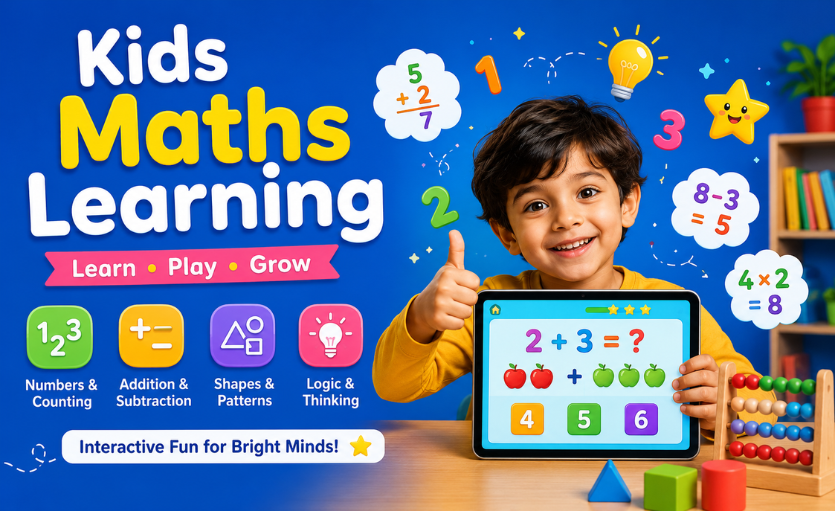
Children can also practise early maths through interactive digital games. Colourful interfaces, easy tasks, music and rapid feedback can make practicing more appealing.
A good educational app should offer new exercises so children can explore counting and number ideas, without completing the same activity over and over.
Advantages Of Learning With Games
Play-based learning can help make educational tasks feel more natural to children. If a child is interested in an activity, they are more likely to participate, repeat activities and seek new solutions.
Number games can help to develop a range of early learning skills:
Number Recognition: Children learn about numbers and what they look like.
Counting: Repeating counting exercises helps children develop number order and one-to-one counting.
Problem Solving: Easy puzzles ask children to think about what happens next or what answer fits.
Memory: Repeating numbers and sequences helps kids to recall basic concepts.
Confidence: When kids have mastered age-appropriate difficulties, they feel more at ease with arithmetic activities.
The aim is to make activities fun and developmentally appropriate.
Number Practice Making It More Fun For Parents
Parents don’t need fancy materials to begin number learning. There are lots of opportunities in everyday settings.
Let your child count fruit during a snack, count steps while walking, or find numerals on a clock. Children can also be encouraged to sort objects by size or colour and then count each group.
Make sessions brief and cheerful. If a kid gets bored with it , sometimes it is better to change activities or take a break than to force them to go on .
It’s also helpful to applaud effort instead than focusing just on getting every answer correct. Fostering curiosity can help children establish a positive attitude toward learning.
Choosing Suitable Activities For Preschoolers
When you are choosing Number Games Preschool activities, seek for material that is appropriate to a child’s present ability. Activities need to be well-instructed, visually basic and progressively challenging.
Parents may also search for age-appropriate educational apps that include fun activities and a simple user interface for digital learning. The best option is dependent on the child’s interests, their learning level and sort of practice they require.
Screen time should not replace active play, creative play, reading, and real-world learning.
Incorporate Numbers Into Playtime
Teaching numbers doesn’t have to be rigidly confined to a formal class. You can introduce games of counting as you play with blocks, draw, sing, sort toys or look at a clock.
Number Games Preschool games are an easy way to turn these ordinary encounters into useful early numeracy work. With the right amount of play, repetition, encouragement and age appropriate challenges youngsters can slowly build up better number awareness and more confidence.
Early maths is not only about recognising numbers. It’s about children making sense of quantities, sequences, patterns and simple relationships. Preschoolers can have some fun while they get practice with these ideas by playing fun games.
Parents and teachers can easily include numbers into a child’s play using toys, number cards, classroom activities or digital learning tools. Enjoyable Number Games Preschool games provide youngsters their initial steps toward developing a strong and positive foundation for future mathematical study.
EduGamingAppWorld offers creative learning experiences that make early learning more fun for children with interactive activities.
DOWNLOAD APP
FAQ
- What are Number Games Preschool?
Number Games Preschool are fun, interactive activities designed to help young children learn numbers, counting, number recognition, and basic maths concepts through play. - What skills can children develop with Number Games Preschool?
These games can support counting, number recognition, sequencing, simple addition, problem-solving, concentration, and early mathematical thinking in an engaging way. - Are Number Games Preschool suitable for early learners?
Yes. Number Games Preschool are designed around simple, age-appropriate activities that make early number learning enjoyable and easier for preschool-aged children.